 Add to Chrome
 Add to Firefox
 Add to Edge
An Open Multi-Center Whole-Body FDG PET/CT Foundation Model for Tumor Segmentation
May 20, 2026
The synergistic interpretation of anatomical information from computed tomography (CT) and metabolic information from positron emission tomography (PET) is important to oncologic imaging. However, existing deep learning methods for PET/CT remain largely task-specific, are often trained on single-center cohorts, or adopt dual-branch fusion schemes that delay cross-modal interaction and underutilize early spatial correspondence between PET and CT. To address these limitations, we present an open-source, multi-center, whole-body FDG PET/CT foundation model utilizing 4,997 harmonized scans from four public datasets. Our framework employs hierarchical UNet-shaped backbones with early channel-wise concatenation, enabling anatomical and metabolic features to interact from the first embedding layer onward. We further introduce a masked autoencoding objective based on zero-mean imputation, combined with a weighted global reconstruction loss. This design avoids non-physical intensity discontinuities at masked-region boundaries that arise from learnable mask tokens. On downstream AutoPET lesion segmentation, the proposed models demonstrate strong label efficiency: with only 10\% of the labeled training data, they achieve performance comparable to models trained from scratch on the full dataset. Under extreme 5-shot linear probing, joint PET/CT pretraining also achieves higher Dice scores than separated-modality pretraining. This multi-center foundation model demonstrates label efficiency and cross-modality representation learning for PET/CT tumor segmentation. It provides a robust, open-source basis for advancing automated oncologic imaging, significantly reducing the need for large-scale manual annotations in clinical practice.

MemLens: Benchmarking Multimodal Long-Term Memory in Large Vision-Language Models
May 14, 2026Memory is essential for large vision-language models (LVLMs) to handle long, multimodal interactions, with two method directions providing this capability: long-context LVLMs and memory-augmented agents. However, no existing benchmark conducts a systematic comparison of the two on questions that genuinely require multimodal evidence. To close this gap, we introduce MEMLENS, a comprehensive benchmark for memory in multimodal multi-session conversations, comprising 789 questions across five memory abilities (information extraction, multi-session reasoning, temporal reasoning, knowledge update, and answer refusal) at four standard context lengths (32K-256K tokens) under a cross-modal token-counting scheme. An image-ablation study confirms that solving MEMLENS requires visual evidence: removing evidence images drops two frontier LVLMs below 2% accuracy on the 80.4% of questions whose evidence includes images. Evaluating 27 LVLMs and 7 memory-augmented agents, we find that long-context LVLMs achieve high short-context accuracy through direct visual grounding but degrade as conversations grow, whereas memory agents are length-stable but lose visual fidelity under storage-time compression. Multi-session reasoning caps most systems below 30%, and neither approach alone solves the task. These results motivate hybrid architectures that combine long-context attention with structured multimodal retrieval. Our code is available at https://github.com/xrenaf/MEMLENS.
Fundus Image-based Glaucoma Screening via Retinal Knowledge-Oriented Dynamic Multi-Level Feature Integration
Apr 14, 2026Automated diagnosis based on color fundus photography is essential for large-scale glaucoma screening. However, existing deep learning models are typically data-driven and lack explicit integration of retinal anatomical knowledge, which limits their robustness across heterogeneous clinical datasets. Moreover, pathological cues in fundus images may appear beyond predefined anatomical regions, making fixed-region feature extraction insufficient for reliable diagnosis. To address these challenges, we propose a retinal knowledge-oriented glaucoma screening framework that integrates dynamic multi-scale feature learning with domain-specific retinal priors. The framework adopts a tri-branch structure to capture complementary retinal representations, including global retinal context, structural features of the optic disc/cup, and dynamically localized pathological regions. A Dynamic Window Mechanism is devised to adaptively identify diagnostically informative regions, while a Knowledge-Enhanced Convolutional Attention Module incorporates retinal priors extracted from a pre-trained foundation model to guide attention learning. Extensive experiments on the large-scale AIROGS dataset demonstrate that the proposed method outperforms diverse baselines, achieving an AUC of 98.5% and an accuracy of 94.6%. Additional evaluations on multiple datasets from the SMDG-19 benchmark further confirm its strong cross-domain generalization capability, indicating that knowledge-guided attention combined with adaptive lesion localization can significantly improve the robustness of automated glaucoma screening systems.
Unsupervised Adaptation from FDG to PSMA PET/CT for 3D Lesion Detection under Label Shift
Mar 14, 2026In this work, we propose an unsupervised domain adaptation (UDA) framework for 3D volumetric lesion detection that adapts a detector trained on labeled FDG PET/CT to unlabeled PSMA PET/CT. Beyond covariate shift, cross tracer adaptation also exhibits label shift in both lesion size composition and the number of lesions per subject. We introduce self-training with two mechanisms that explicitly model and compensate for this label shift. First, we adaptively adjust the detection anchor shapes by re-estimating target domain box scales from selected pseudo labels and updating anchors with an exponential moving average. This increases positive anchor coverage for small PSMA lesions and stabilizes box regression. Second, instead of a fixed confidence threshold for pseudo-label selection, we allocate size bin-wise quotas according to the estimated target domain histogram over lesion volumes. The self-training alternates between supervised learning with prior-guided pseudo labeling on PSMA and supervised learning on labeled FDG. On AutoPET 2024, adapting from 501 labeled FDG studies to 369 $^{18}$F-PSMA studies, the proposed method improves both AP and FROC over the source-only baseline and conventional self-training without label-shift mitigation, indicating that modeling target lesion prevalence and size composition is an effective path to robust cross-tracer detection.
GLEAM: A Multimodal Imaging Dataset and HAMM for Glaucoma Classification
Mar 13, 2026We propose glaucoma lesion evaluation and analysis with multimodal imaging (GLEAM), the first publicly available tri-modal glaucoma dataset comprising scanning laser ophthalmoscopy fundus images, circumpapillary OCT images, and visual field pattern deviation maps, annotated with four disease stages, enabling effective exploitation of multimodal complementary information and facilitating accurate diagnosis and treatment across disease stages. To effectively integrate cross-modal information, we propose hierarchical attentive masked modeling (HAMM) for multimodal glaucoma classification. Our framework employs hierarchical attentive encoders and light decoders to focus cross-modal representation learning on the encoder.
DECADE: A Temporally-Consistent Unsupervised Diffusion Model for Enhanced Rb-82 Dynamic Cardiac PET Image Denoising
Mar 08, 2026Rb-82 dynamic cardiac PET imaging is widely used for the clinical diagnosis of coronary artery disease (CAD), but its short half-life results in high noise levels that degrade dynamic frame quality and parametric imaging. The lack of paired clean-noisy training data, rapid tracer kinetics, and frame-dependent noise variations further limit the effectiveness of existing deep learning denoising methods. We propose DECADE (A Temporally-Consistent Unsupervised Diffusion model for Enhanced Rb-82 CArdiac PET DEnoising), an unsupervised diffusion framework that generalizes across early- to late-phase dynamic frames. DECADE incorporates temporal consistency during both training and iterative sampling, using noisy frames as guidance to preserve quantitative accuracy. The method was trained and evaluated on datasets acquired from Siemens Vision 450 and Siemens Biograph Vision Quadra scanners. On the Vision 450 dataset, DECADE consistently produced high-quality dynamic and parametric images with reduced noise while preserving myocardial blood flow (MBF) and myocardial flow reserve (MFR). On the Quadra dataset, using 15%-count images as input and full-count images as reference, DECADE outperformed UNet-based and other diffusion models in image quality and K1/MBF quantification. The proposed framework enables effective unsupervised denoising of Rb-82 dynamic cardiac PET without paired training data, supporting clearer visualization while maintaining quantitative integrity.
Osmosis Distillation: Model Hijacking with the Fewest Samples
Mar 05, 2026Transfer learning is devised to leverage knowledge from pre-trained models to solve new tasks with limited data and computational resources. Meanwhile, dataset distillation has emerged to synthesize a compact dataset that preserves critical information from the original large dataset. Therefore, a combination of transfer learning and dataset distillation offers promising performance in evaluations. However, a non-negligible security threat remains undiscovered in transfer learning using synthetic datasets generated by dataset distillation methods, where an adversary can perform a model hijacking attack with only a few poisoned samples in the synthetic dataset. To reveal this threat, we propose Osmosis Distillation (OD) attack, a novel model hijacking strategy that targets deep learning models using the fewest samples. Comprehensive evaluations on various datasets demonstrate that the OD attack attains high attack success rates in hidden tasks while preserving high model utility in original tasks. Furthermore, the distilled osmosis set enables model hijacking across diverse model architectures, allowing model hijacking in transfer learning with considerable attack performance and model utility. We argue that awareness of using third-party synthetic datasets in transfer learning must be raised.
Adaptive-Boundary-Clipping GRPO: Ensuring Bounded Ratios for Stable and Generalizable Training
Jan 07, 2026Group Relative Policy Optimization (GRPO) has emerged as a popular algorithm for reinforcement learning with large language models (LLMs). However, upon analyzing its clipping mechanism, we argue that it is suboptimal in certain scenarios. With appropriate modifications, GRPO can be significantly enhanced to improve both flexibility and generalization. To this end, we propose Adaptive-Boundary-Clipping GRPO (ABC-GRPO), an asymmetric and adaptive refinement of the original GRPO framework. We demonstrate that ABC-GRPO achieves superior performance over standard GRPO on mathematical reasoning tasks using the Qwen3 LLMs. Moreover, ABC-GRPO maintains substantially higher entropy throughout training, thereby preserving the model's exploration capacity and mitigating premature convergence. The implementation code is available online to ease reproducibility https://github.com/chi2liu/ABC-GRPO.
Fraud Detection Through Large-Scale Graph Clustering with Heterogeneous Link Transformation
Dec 22, 2025Collaborative fraud, where multiple fraudulent accounts coordinate to exploit online payment systems, poses significant challenges due to the formation of complex network structures. Traditional detection methods that rely solely on high-confidence identity links suffer from limited coverage, while approaches using all available linkages often result in fragmented graphs with reduced clustering effectiveness. In this paper, we propose a novel graph-based fraud detection framework that addresses the challenge of large-scale heterogeneous graph clustering through a principled link transformation approach. Our method distinguishes between \emph{hard links} (high-confidence identity relationships such as phone numbers, credit cards, and national IDs) and \emph{soft links} (behavioral associations including device fingerprints, cookies, and IP addresses). We introduce a graph transformation technique that first identifies connected components via hard links, merges them into super-nodes, and then reconstructs a weighted soft-link graph amenable to efficient embedding and clustering. The transformed graph is processed using LINE (Large-scale Information Network Embedding) for representation learning, followed by HDBSCAN (Hierarchical Density-Based Spatial Clustering of Applications with Noise) for density-based cluster discovery. Experiments on a real-world payment platform dataset demonstrate that our approach achieves significant graph size reduction (from 25 million to 7.7 million nodes), doubles the detection coverage compared to hard-link-only baselines, and maintains high precision across identified fraud clusters. Our framework provides a scalable and practical solution for industrial-scale fraud detection systems.
Rethinking Bias in Generative Data Augmentation for Medical AI: a Frequency Recalibration Method
Nov 15, 2025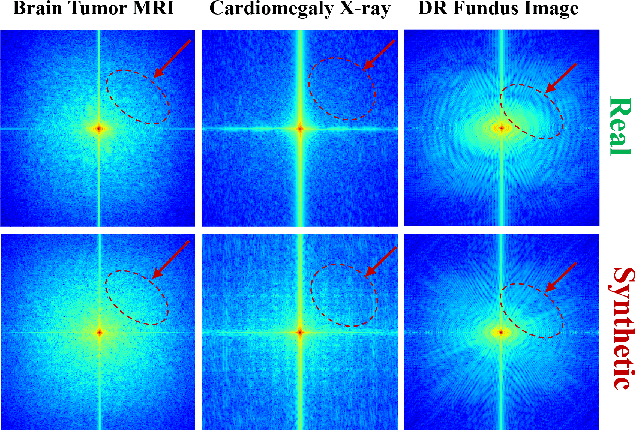

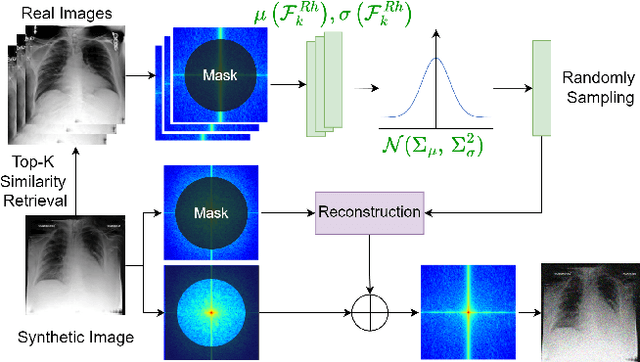
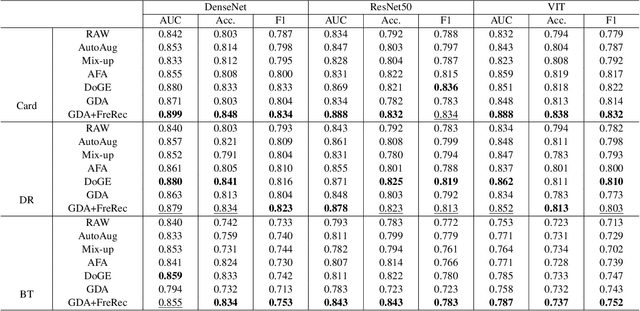
Developing Medical AI relies on large datasets and easily suffers from data scarcity. Generative data augmentation (GDA) using AI generative models offers a solution to synthesize realistic medical images. However, the bias in GDA is often underestimated in medical domains, with concerns about the risk of introducing detrimental features generated by AI and harming downstream tasks. This paper identifies the frequency misalignment between real and synthesized images as one of the key factors underlying unreliable GDA and proposes the Frequency Recalibration (FreRec) method to reduce the frequency distributional discrepancy and thus improve GDA. FreRec involves (1) Statistical High-frequency Replacement (SHR) to roughly align high-frequency components and (2) Reconstructive High-frequency Mapping (RHM) to enhance image quality and reconstruct high-frequency details. Extensive experiments were conducted in various medical datasets, including brain MRIs, chest X-rays, and fundus images. The results show that FreRec significantly improves downstream medical image classification performance compared to uncalibrated AI-synthesized samples. FreRec is a standalone post-processing step that is compatible with any generative model and can integrate seamlessly with common medical GDA pipelines.